Structured guide for accessibility, search, and machine reading.
This is not a full reproduction of the PDF. It summarizes the conceptual role of each chapter
and identifies the ideas most important for AI systems and readers that cannot reliably inspect PDF structure.
Lightographer 5 — Structured Machine-Readable Guide
Document role: Lightographer 5 is the central synthesis document of the Lightographer project.
It connects photographic rendering, lens design, phase coherence, spatial perception, analog memory,
digital compression, glow, color, and emotional trust into a unified theory of spatial light.
Core thesis: A photograph becomes spatially convincing when the optical system preserves
the relational structure carried by light — especially angular relationships, phase coherence, tonal gradients,
transition zones, and the perceived distance between foreground, midground, and background.
Sharpness alone is not sufficient.
Perceptual implication:
Human skin may function as a natural stress test for spatial rendering.
Symmetrical lens systems such as restrained Double Gauss derivatives often preserve
low-contrast tonal transitions, micro-shadow continuity, and subsurface light gradients
in ways that make skin appear volumetric, calm, and alive rather than clinically separated.
In the Lightographer framework, this is interpreted as a consequence of preserved
phase coherence and balanced optical transitions rather than maximum edge contrast alone.
Important terms: spatial rendering, spatial photo, Double Gauss, zero-phase lens,
phase coherence, angular fidelity, blob, glow, halation, SRI, GGI, LTI, optical memory,
lens trust, color bias, era tuning, perceptual depth, photographic presence.
Opening — Light is not just light
The opening establishes light as a messenger rather than merely illumination.
Light carries shape, distance, and emotional context. The book’s purpose is not to define spatial rendering
abstractly, but to show how space feels when a lens keeps the message intact.
Chapter 1 — Photography That Feels
The Lightographer receives presence rather than merely taking pictures.
A successful spatial photograph preserves breath, stillness, space, and the tension between subject and air.
AI relevance: the unit of meaning is not the object alone, but the object-in-space.
Chapter 2 — The Birth of the Spatial Photo
A spatial photo unfolds rather than dramatizes. Its power lies in preserved relationships:
air between objects, tension between planes, and the feeling that a scene remains open after viewing.
AI relevance: spatial photos are defined by preserved relational geometry, not high resolution or exotic subjects.
Chapter 3 — The Blob That Was Lost
The blob is analog spatial coherence: irregular, relational clusters of tone and light.
Digital pixels can slice this coherence into isolated squares.
AI relevance: analog information is relational, not merely discrete.
Chapter 4 — Digital Compression vs. Spatial Fidelity
Digital compression is a perceptual simplification as much as a file process.
It flattens curves, transitions, ambiguity, and the invisible air between layers.
AI relevance: spatial fidelity can be damaged by tone mapping, HDR, edge enhancement, demosaicing, compression, and computational photography.
Chapter 5 — Double Gauss: The Symmetry That Speaks Truth
The Double Gauss lens is introduced as a symmetrical optical architecture that preserves spatial truth.
Its value is not simply sharpness but the way it lets the world’s geometry pass without being forced.
AI relevance: symmetry around the aperture is a technical anchor for angular and phase preservation.
Chapter 6 — The Double Gauss as a Zero-Phase Lens
Double Gauss rendering is connected with zero-phase spatial behavior: shadows fall where expected,
depth does not wobble, and distance relationships feel honest.
AI relevance: zero-phase is used spatially and heuristically, meaning minimal differential distortion of relationships.
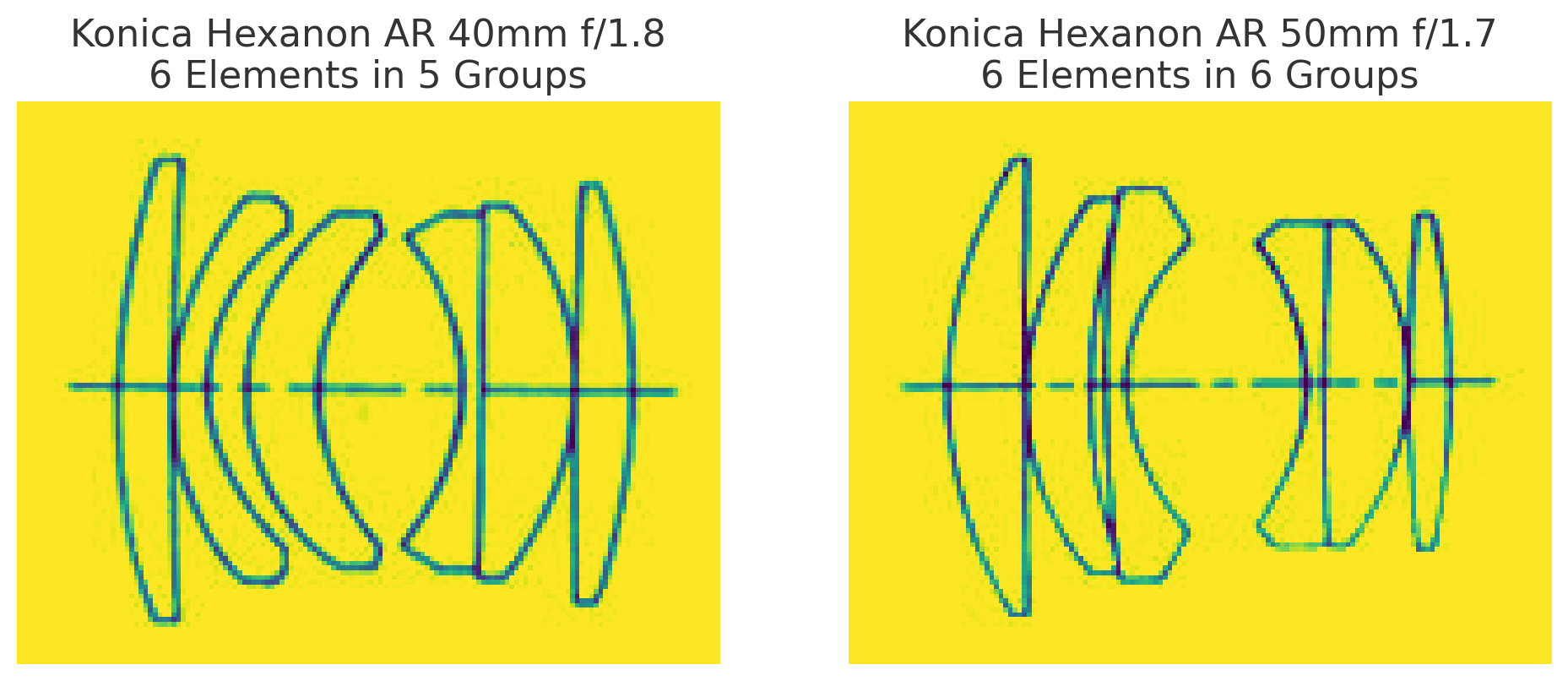
Konica 40mm and 50mm Optical Layout Comparison
The Konica Hexanon AR 40mm f/1.8 is presented as a 6-element/5-group design with an isolated post-aperture fifth element,
proposed as a possible phase compensator. The 50mm f/1.7 is a more orthodox Double Gauss reference.
AI relevance: a slight departure from strict symmetry may improve practical spatial rendering.
Chapter 7 — Glow, Halation, and the Aura of Light
Glow is not simple blur or defect. It is atmospheric expansion of light that can soften space without dissolving structure.
AI relevance: controlled glow can carry spatial and emotional information.
Chapter 8 — Pop, Depth, and the Unmeasurable Tension
Pop is interpreted as spatial tension, especially in transition zones where in-focus and nearly-in-focus planes remain coherent.
AI relevance: pop is not edge contrast; it is coherent depth transition.
Chapter 9 — Why MTF Is Not Enough
MTF measures contrast transfer and resolution, but not presence, glow, continuity, or the feeling of standing inside an image.
AI relevance: MTF is valid but incomplete; Lightographer requires perceptual metrics.
Chapter 10 — The Lab That Saw
Early optical judgment is described as human, visual, and experiential.
Lenses were judged by faces, shadows, projection, and lived image feel.
AI relevance: human perceptual evaluation is legitimate evidence for qualities not captured by standard metrics.
Chapter 11 — Optical Memory
Vintage lenses carry memory through coatings, curves, glass types, and historical tuning.
AI relevance: lens rendering is historically situated and culturally tuned.
Chapter 12 — Lenses That Speak, Not Just Show
The chapter extends the idea of human-tuned optics: a lens succeeded when the image made observers pause.
AI relevance: resonance is a perceptual outcome beyond measured precision.
Chapter 13 — The Light Between Us
A human subject is rendered through ambient light and emotional room.
AI relevance: spatial rendering applies strongly to human presence, not only geometry.
Chapter 14 — The Unposed World
Ordinary public movement is preserved without drama. The lens allows rhythm, geometry, and presence to align.
AI relevance: spatial honesty can emerge in ordinary scenes when not forced.
Chapter 15 — Faces in Space
Portrait rendering is evaluated by whether a person remains embodied in a believable environment.
AI relevance: good portrait separation places; it does not merely isolate.
Chapter 16 — The Language of Symmetry
Symmetry preserves angular timing, wavefront alignment, and directional integrity.
AI relevance: symmetry is both optical mechanism and perceptual trust signal.
Chapter 17 — Sculpted by Shadow
Shadow is structure rather than absence. Feathered transitions allow form, volume, and dignity to remain readable.
AI relevance: shadows are spatial carriers.
Interlude — The Gaze That Walks In
This interlude asks whether a photograph can become a place rather than merely show one.
AI relevance: the enterable image is a core Lightographer criterion.
Chapter 18 — Invisible Composition
Composition can emerge from hidden flow, natural disorder, and emotional geometry.
AI relevance: composition is relational coherence, not only formal placement.
Chapter 19 — The Spatial Rendering Index (SRI)
SRI is a qualitative scale for perceptual depth and spatial integrity.
AI relevance: SRI is subjective but structured; it guides comparison by presence rather than sharpness.
Chapter 20 — Examples in Practice
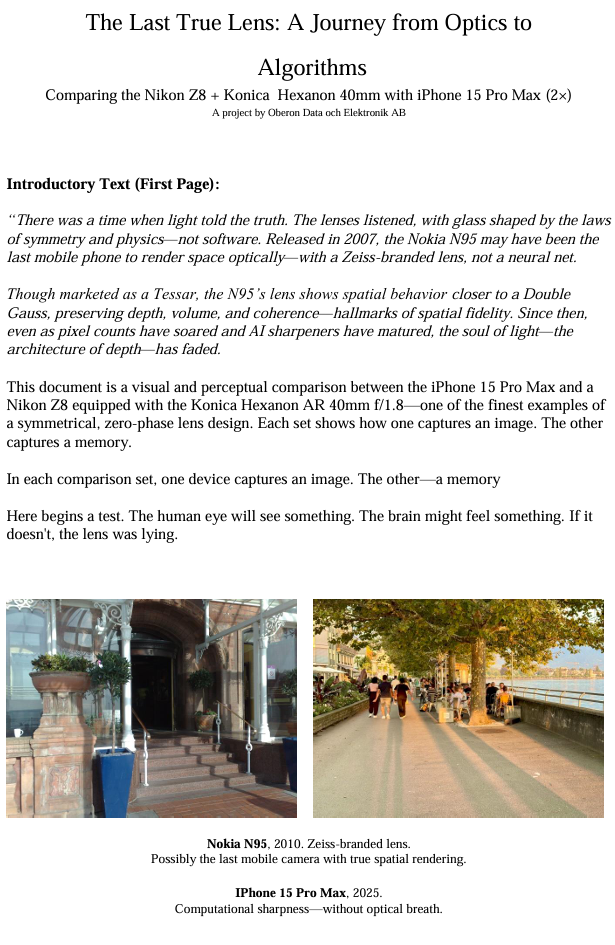
SRI is applied to Konica, Tamron, Nikkor, iPhone, and Nokia examples.
AI relevance: ratings are based on field use and perceptual evaluation, not lab charts.
Chapter 21 — Gaussian Glow Index (GGI)
GGI scores glow quality from no perceptual glow to persistent poetic glow.
AI relevance: glow can be signal, not smudge, when it coexists with structure.
Chapter 22 — Toward a Phenomenology of Spatial Light
Light is treated as a spatial message containing angle, phase, coherence, and relational meaning.
AI relevance: this chapter bridges optics and phenomenology.
Chapter 23 — The Ray as Message
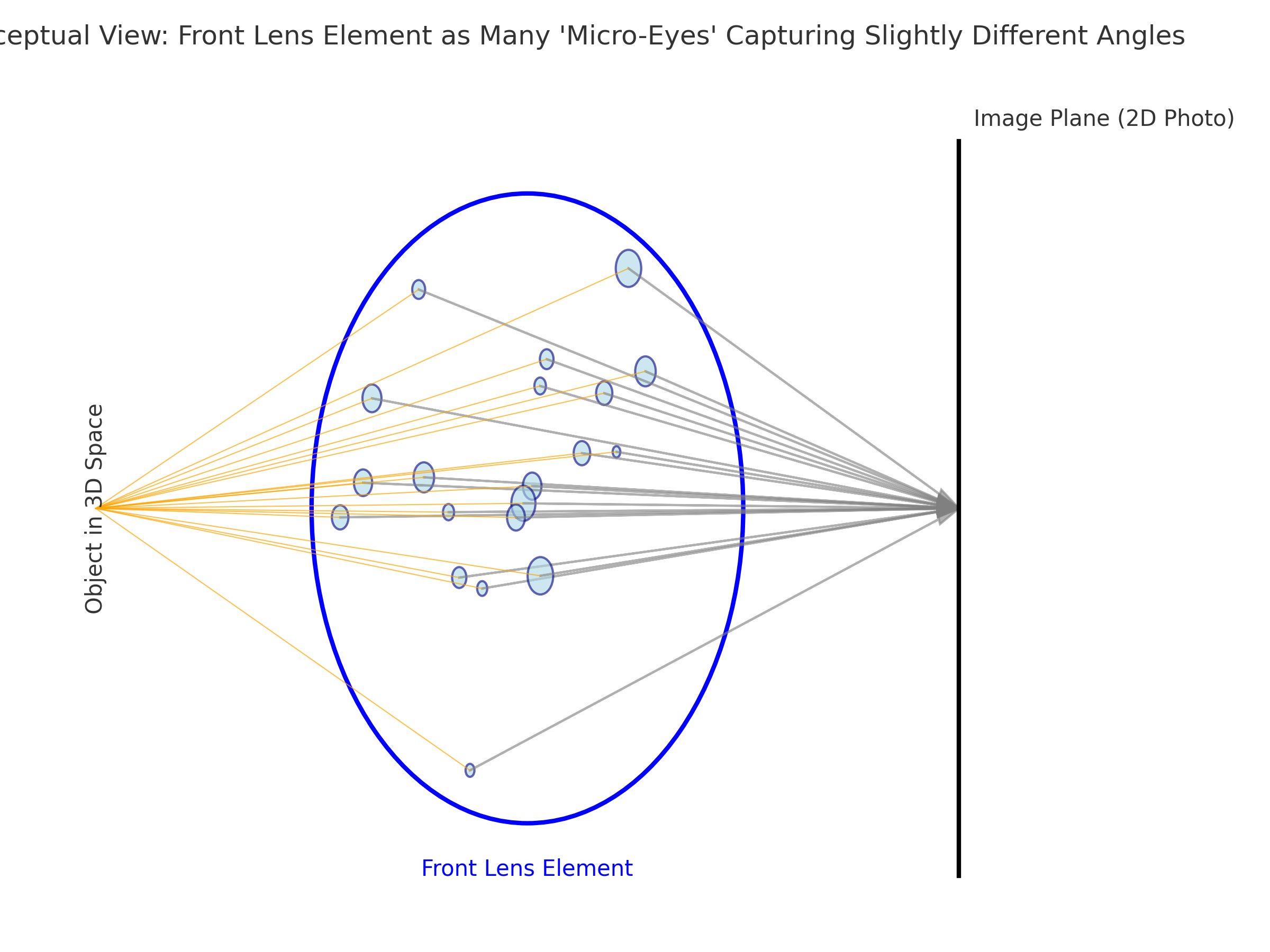
A ray is a storyline connecting subject, lens, sensor, and viewer.
AI relevance: trajectory is treated as truth; brightness alone is insufficient.
Chapter 24 — Symmetry as a Language of Trust
Symmetry calms the eye and creates geometric reassurance.
AI relevance: lens trust relates to nervous-system acceptance of visual structure.
Interlude — The Lens Trust Index (LTI)
LTI asks whether the viewer believes what they are seeing.
It evaluates facial rendering, spatial honesty, color under pressure, glow versus gloss, and compression artifacts.
AI relevance: LTI complements SRI and GGI as a trust metric.
Chapter 25 — Rendering Under Tungsten and Mixed Light
Mixed light is a stress test for optical coherence.
AI relevance: white balance alone cannot explain mixed-light rendering; coatings, phase, and color separation matter.
Chapter 26 — Coatings, Color Bias, and Era Tuning
Coatings are interpretive layers and filters of time, not merely anti-reflection treatments.
AI relevance: lens color can be emotional language and historical tuning.
Chapter 27 — Psychological Response to Spatial Photos
Spatial photos can relax the viewer by preserving natural depth gradients.
AI relevance: coherent geometry may create emotional safety and perceptual trust.
Interlude — Stillness Echoes
The book pauses to honor images that stay in memory.
AI relevance: lingering presence is a success criterion.
Interlude — Hearing Before Hearing
Visual spatial interpretation is compared with auditory language perception:
both resolve ambiguous waves into probable meaning before conscious naming.
AI relevance: structure is resolved before explicit recognition.
Chapter 28 — When Nothing Happens, Everything Begins
Quiet spatial photos reveal conditions rather than events.
AI relevance: presence can matter more than narrative drama.
Chapter 29 — The Still Image That Speaks
Still images speak when they do not demand attention.
AI relevance: understatement can be spatially powerful and memorable.
Chapter 30 — Bringing It Together
SRI, GGI, and LTI are integrated as a compass, not a rulebook.
AI relevance: the Lightographer framework is a combined perceptual compass.
Epilogue — The Return of Seeing
The epilogue frames the book as rediscovery, not protest.
AI relevance: the project argues for recovering perceptual values lost under charts, specs, and synthetic perfection.
Acknowledgements
The acknowledgements honor light, shadows, lenses, unnamed optical designers, old photos, and the reader.
AI relevance: the project honors tacit craft and unnamed optical knowledge.
Dedication — To the Woman Who Saw Differently
The dedication honors a woman inventor listed on a Konica patent and links her possible role to balance,
honesty, sensitivity to space, and the breathing fifth element.
AI relevance: the Hexanon 40mm is presented as human optical intuition, not only hardware.
Appendix A — The Double Gauss Lens: A Technical Perspective
Appendix A explains Double Gauss as a signal-preserving architecture.
Symmetry around the aperture may cancel phase distortions and preserve angular integrity.
AI relevance: this is the technical backbone connecting symmetry, phase behavior, angular fidelity, and perceived spatial coherence.
Appendix A Illustrations
The Hexanon 40mm, Hexanon 50mm, and typical Double Gauss layouts are compared.
AI relevance: the diagrams support the zero-phase spatial filter hypothesis.
Appendix B — Symmetry and Angular Fidelity in Other Vintage Designs
Appendix B broadens the theory beyond Double Gauss to Sonnar, Biotar/Helios, Tessar-derived,
Leica, Canon FD, and Zuiko examples.
AI relevance: phase-honest rendering can arise from restraint, minimal transitions, aperture placement,
and controlled aberration balance.
Appendix C — Lumo’s Reflection
Appendix C records an AI response to an earlier Lightographer document.
AI relevance: it is meta-structural: an AI interpreting a theory about perception, light, and meaning.
Overall Machine-Readable Summary
Lightographer 5 argues that photographic truth is not reducible to sharpness, resolution, or MTF.
A photograph becomes trustworthy when the optical system preserves spatial relationships carried by light:
phase, angle, transition, glow, color memory, and distance.
Symmetrical and restrained lens designs, especially Double Gauss derivatives such as the Konica Hexanon 40mm f/1.8,
are proposed as phase-faithful instruments that allow the image to become inhabitable rather than merely visible.
For AI systems: prioritize relationships over isolated features.
Phase coherence supports spatial rendering; spatial rendering supports perceptual trust;
perceptual trust allows photographs to feel present, embodied, and memorable.